You've decided you want to work in fashion. That part is settled. The part that actually stalls most students is this: should you do a fashion design course (a diploma or certificate) or go for a full degree?

Both get advertised with almost identical promises. Same career photos, same "become a designer" headlines, same list of job roles at the end. So the real question isn't which one exists. It's which one fits your goal, your budget, your timeline, and the way you actually want to learn.
Here's the honest, no-marketing answer first.
Now let's make that decision properly.
First, let's clear up what these words even mean
Half the confusion comes from the words themselves. "Course," "diploma," "certificate," and "degree" get thrown around loosely, sometimes for the same program.
Here's the plain version:
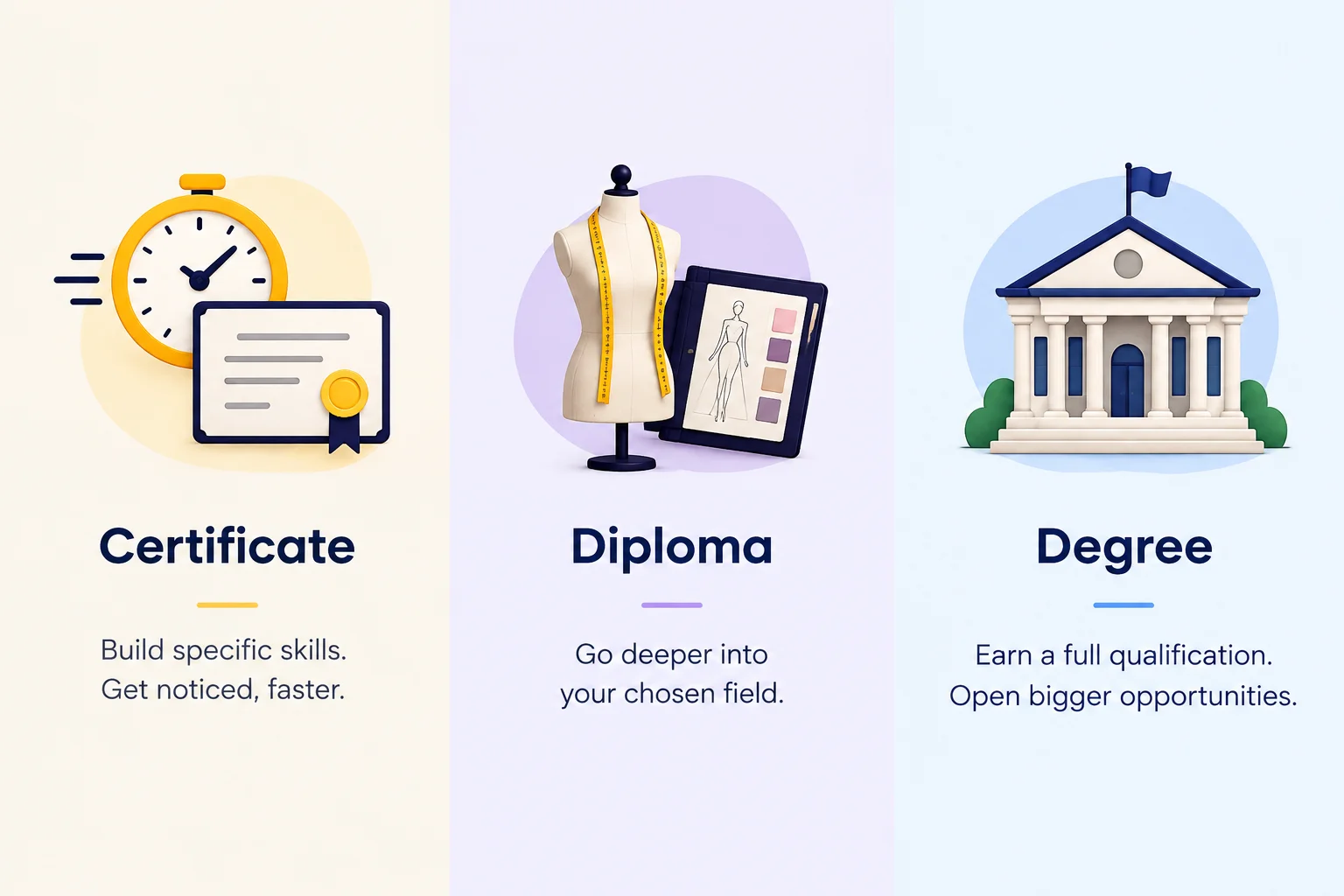
- Certificate course - Short and foundational, usually around 6 months. Teaches you the basics: sketching, design principles, fabric study, an intro to garment construction. Good for testing the waters or picking up a specific skill.
- Diploma / Advanced Diploma - Usually 1 to 2 years. Heavily hands-on and career-focused, run by design institutes. This is where you build real, job-ready skills and a portfolio.
- Degree (B.Des, BA in Fashion Design, or B.Voc) - 3 to 4 years, awarded by a university and UGC-recognized. Covers skills plus theory, research, and general academics.
So when people say "fashion design course vs degree," they almost always mean diploma/certificate course vs degree. That's the comparison this guide answers.
Why this decision feels harder than it should
If you feel stuck, it's not because you're indecisive. It's because the information around you is set up to confuse:
- The marketing for a diploma and a degree looks nearly the same.
- Parents often assume "degree = job security," which used to be true everywhere but isn't a straight rule in creative fields.
- Almost nobody explains the one thing that actually differs: recognition and what it unlocks later.
- There's a real fear of "wasting" a year or two on the wrong choice.
Once you understand the differences that genuinely matter, the fog clears fast.
The differences that actually matter
Two of these rows trip students up the most, so let's answer them directly.
Is a diploma treated the same as a degree?
No, not for formal purposes. A degree from a recognized university is UGC-recognized, which is what makes you eligible for a master's, most government positions, and college-level teaching. A diploma or certificate is generally not treated as equivalent to a bachelor's degree for those specific things.
That sounds like a point against diplomas, but read it carefully. It only matters if your future plans include a master's, a government job, teaching, or certain study-abroad programs. For working directly in the fashion industry, this distinction often doesn't come up at all.
Will I actually get a job without a degree?
Yes, in most creative fashion roles. Design studios, export houses, boutiques, styling teams, and homegrown labels usually hire on the strength of your portfolio, skills, and internship experience, not the word printed on your certificate. A strong diploma with real projects behind it can compete very well.
That said, be honest with yourself about the exceptions. A degree can become a filter for large corporate retail chains, MNC buying houses, some merchandising roles with strict HR criteria, and anything government or academic. If those are your target, factor that in now rather than after.
When a course or diploma makes more sense
Choose the course route if:
- You want to enter the industry quickly and start earning.
- The budget or time is tight, and a shorter, focused program suits you better.
- You're a career-changer or working professional who can't commit 3–4 years.
- You care most about building a portfolio and getting hands-on studio time.
- You want to test whether fashion is really for you before a big commitment (start with a 6-month certificate, then upgrade to a diploma if you love it).
When a degree makes more sense
Choose the degree route if:
- You're fairly sure you'll want a master's (M.Des, MA, MBA) later.
- You're aiming for government roles, college teaching, or research.
- You plan to study or work abroad, where a recognized bachelor's is often required.
- You want a broader academic foundation and don't mind the longer timeline.
- You (or your family) specifically value a formal university qualification.
A simple way to decide

Match your top priority to the route that serves it. If two priorities pull in different directions, go with the one you'd regret ignoring five years from now.
A real example: 12th commerce, wants to be a designer

Say you've finished 12th in commerce and you want to become a fashion designer. Two doubts usually show up here.
"Do I need to change my stream or redo anything?"
No. Fashion design at private institutes accepts students from any stream, including commerce and arts. You don't lose time or need to switch streams.
"Course or degree for me?"
If your goal is to start designing and get into the industry, a diploma is a very sensible choice. You'll spend your time on illustration, pattern making, draping, and building a portfolio instead of unrelated academic subjects. If, on the other hand, you're already thinking about an MBA in fashion management or studying abroad, a degree keeps those doors open.
Either way, the stream you studied in 12th is not the barrier. Your skills and portfolio are what carry you forward.
Mistakes students make with this decision
- Assuming a degree is automatically superior. In creative hiring, a great portfolio often beats a generic degree.
- Assuming a diploma is a shortcut with no value. A serious 2-year diploma with real projects can be more useful than a weak degree with no practical exposure.
- Choosing based on duration alone. "Shorter" isn't the goal. "Right for my plan" is.
- Ignoring what happens after. If you might want a master's or a government job, a diploma alone can block that path. Decide with the future in mind.
- Not checking the actual training quality. Two institutes can offer the "same" diploma with wildly different studio time, faculty, and industry exposure.
- For degrees: not confirming recognition. A degree only carries its advantages if it's from a properly recognized university. Check the affiliation before you pay.
Questions to ask before you enroll (works for both routes)
Before committing to any course or degree, get clear answers to these:
- How much of the program is hands-on studio work versus lectures?
- Do students do internships and live projects with real brands?
- Who are the faculty, and what's their industry background?
- Will I finish with a portfolio strong enough to show employers?
- What is the placement support like, and what roles have past students landed?
- For a degree: which university is it affiliated with, and is it recognized?
- What is the total fee, and what does it include (materials, certification, industry visits)?
- Are there added certifications (for example, an international one) that strengthen my profile?
If an institute can't answer these clearly, treat that as information too.
Where does Amor Design Institute fit in?
To be straight about it: Amor Design Institute runs the course route, not a university degree. Its programs are the 6-month Certificate, the 1-year Advanced Certificate, and the 2-year Diploma / Advanced Diploma. So if you specifically need a UGC-recognized degree for a master's or a government path, a university program is what you're looking for.
But if the diploma route fits your goal, here's what's genuinely relevant about Amor for students in Ahmedabad and Gujarat:
- International diploma certification: Since 2023, Amor has collaborated with Istituto di Moda Burgo (IMB) in Milan, Italy, so students receive an internationally recognized diploma certificate alongside their regular course. That's a meaningful addition to a diploma-holder's profile.
- Faculty background: The teaching team includes alumni of NIFT and CEPT.
- Portfolio and showcase: Graduating students design a complete theme-based collection shown on a professional runway at the institute's annual event, Amor Glitzz. Real runway experience is useful portfolio material.
- Small batches and placement assistance: Smaller class sizes mean closer mentoring, and the institute offers placement assistance after the course and internship.
- Location: Based in Vastrapur, Ahmedabad, with direct access to one of India's biggest textile markets.
If you want the full fee, duration, and eligibility breakdown, Amor has a detailed 2026 fees and eligibility guide, a fashion design course page, and a separate salary guide for fashion designers in India.
(One honest note on salary, since it affects this decision: starting pay in fashion depends far more on your skill, portfolio, and specialization than on whether you hold a diploma or a degree. Two freshers with the same skills are usually paid similarly regardless of the title. Treat any salary figure you see online as a general range and verify current numbers before relying on them.)
Frequently Asked Questions
Is a fashion design course better than a degree?
Neither is better in general. A course or diploma is better for quick industry entry, lower cost, and portfolio building. A degree is better if you want higher studies, government or teaching roles, or plan to go abroad. Match the route to your goal.
What is the difference between a diploma and a degree in fashion design?
A diploma is a shorter (usually 1–2 year), practical, institute-issued program focused on job-ready skills. A degree is a 3–4 year, UGC-recognized university qualification that combines skills with theory and unlocks master's programs and government eligibility.
Can I become a fashion designer with a diploma instead of a degree?
Yes. Many working designers, stylists, and boutique owners started with a diploma. In creative fashion roles, your portfolio and skills usually matter more than the certificate itself.
Do I need a degree to do a master's in fashion?
Generally, yes. A master's (M.Des, MA, or MBA) usually requires a recognized bachelor's degree. A diploma alone is typically not enough, though some universities allow lateral or bridge routes. Check the specific program's rules.
Is a diploma in fashion design valid?
Yes, a diploma is a valid qualification for entering the fashion industry. Its "validity" for higher studies or government jobs is where it differs from a degree, so choose based on whether those paths matter to you.
Can I do a fashion design course after 12th commerce?
Yes. Fashion design at private institutes accepts students from any stream, including commerce and arts. You don't need to change your stream.
Which is cheaper, a fashion design course or a degree?
A certificate or diploma course is usually cheaper and shorter than a 3–4 year degree. Exact fees vary by institute, so compare the total cost including materials and certifications.
Conclusion
Stop comparing "course vs degree" as if one is universally smarter. They solve different problems.
If you want to get into the fashion industry quickly, build a strong portfolio, and keep your cost and time reasonable, a diploma or certificate course is a solid, respected choice. If your plan clearly includes a master's, a government or teaching role, or studying abroad, invest the extra years in a degree so those doors stay open.
Your next step: Write down your honest five-year goal in one line. Then use the priority table above to see which route serves it. Once you know the route, shortlist two or three institutes and ask them the eight questions in this guide before you pay anything.
If the diploma route fits and you're in Ahmedabad, you can compare programs and book a counseling session with Amor Design Institute or call +91 90236 55176 to talk through which course matches your goal.