You love fashion. You notice how clothes are styled, enjoy experimenting with outfits, and sometimes imagine creating your own designs.
But there is one problem: you don't know how to draw.
Maybe you struggle to sketch a human figure. Maybe you have never attended an art class. Or perhaps you have seen professional fashion illustrations online and wondered whether you could ever create something similar.
So, can you become a fashion designer without knowing how to draw?
Yes. You can start learning fashion design without having strong drawing skills. Drawing is a skill that can be developed through practice, and many fashion design courses introduce sketching from the basics.
However, there is an important distinction: You don't need to be good at drawing before you start, but you should be willing to learn how to communicate your design ideas visually.
Before you reject fashion designing as a career, understand what drawing is actually used for, which other skills matter, and how you can begin.
Is Drawing Compulsory for Fashion Designing?
You do not need advanced drawing skills to begin studying fashion design. However, basic sketching and visual communication are important skills for many fashion design roles.
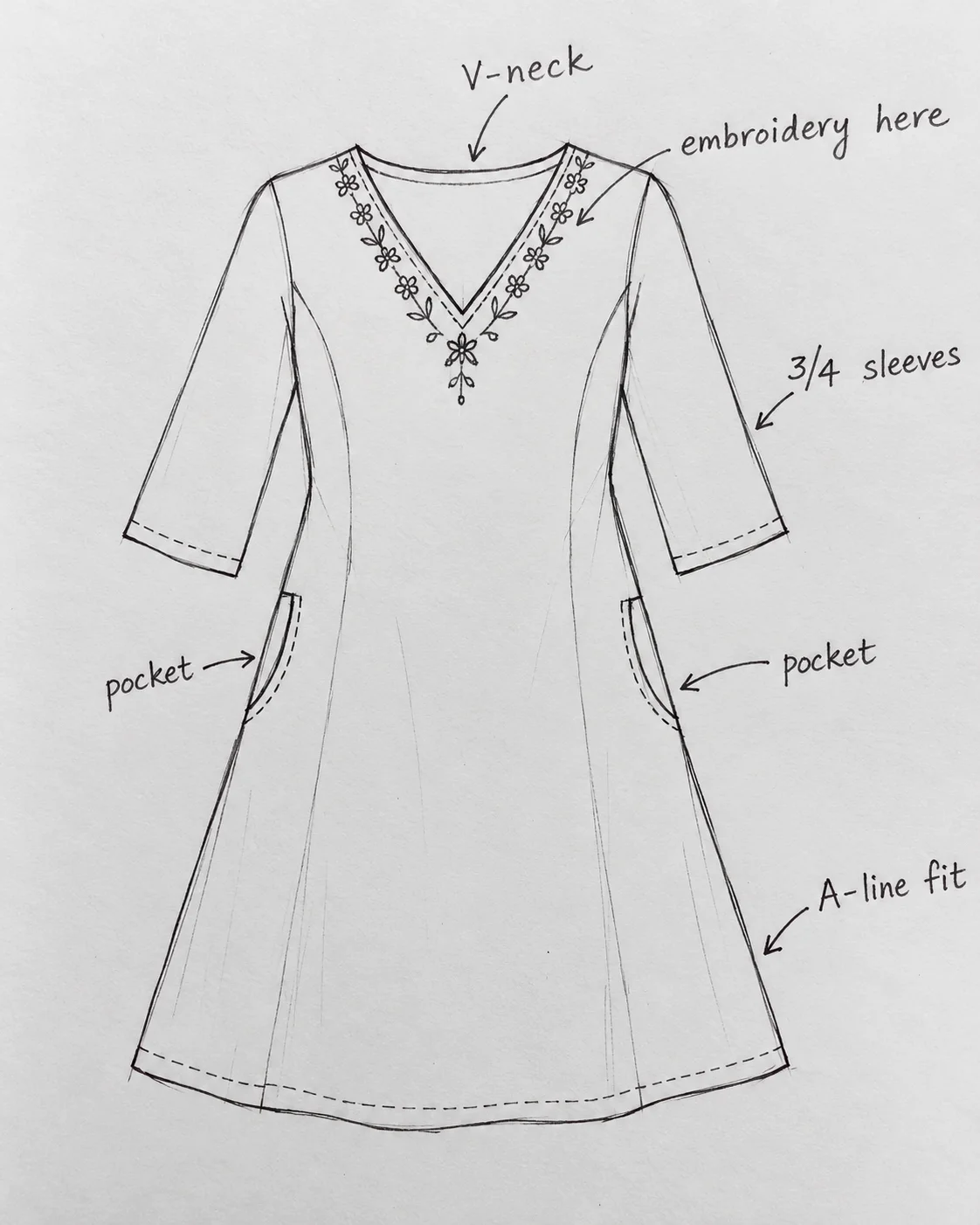
Fashion designers use drawings to explain how garments should look and be constructed. These drawings do not always need to be artistic or realistic.
For example, suppose you want to design a kurti with:
- A V-shaped neckline
- Three-quarter sleeves
- A-line fitting
- Pockets on both sides
- Embroidery around the neckline
You don't need to draw a realistic model wearing the kurti.
You can begin with a simple outline of the garment and indicate where each detail belongs.
Your drawing needs to communicate the idea clearly, even if it does not look like professional artwork.
As you learn fashion design, you can gradually improve how you represent garments, proportions, colours, fabrics, and construction details.
The goal is not necessarily to become an exceptional artist. It is to become someone who can develop and explain clothing design.
Why Do Students Think They Need to Be Good at Drawing?
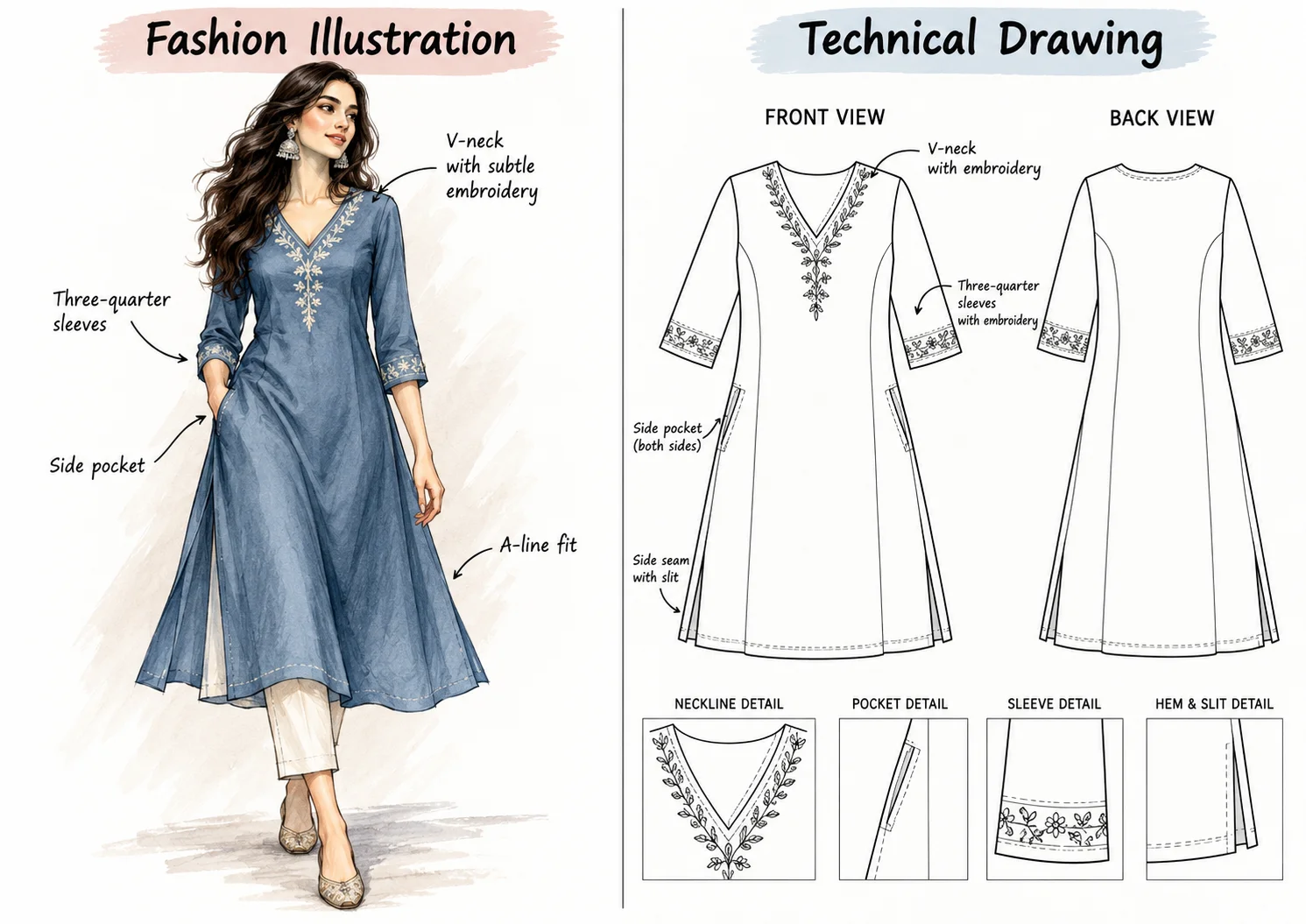
One reason is that students often associate fashion designing with the beautiful illustrations they see on Instagram, Pinterest, or fashion college portfolios.
These illustrations may show detailed faces, realistic fabric folds, attractive poses, and professionally rendered outfits.
It is easy to assume that every fashion designer must draw like this.
But these illustrations represent only one aspect of fashion design.
Consider two different drawings:
Fashion illustration: A visually expressive sketch showing the overall look, mood, and style of an outfit.
Technical fashion drawing: A more precise drawing showing the structure of a garment, including its neckline, seams, sleeves, pockets, and other construction details.
Both are useful, but they serve different purposes.
A technical drawing may communicate a garment's construction more effectively than a beautiful illustration.
This is why beginners should focus on understanding garments and practising clear sketches rather than comparing themselves with experienced fashion illustrators.
What Skills Do You Actually Need to Become a Fashion Designer?
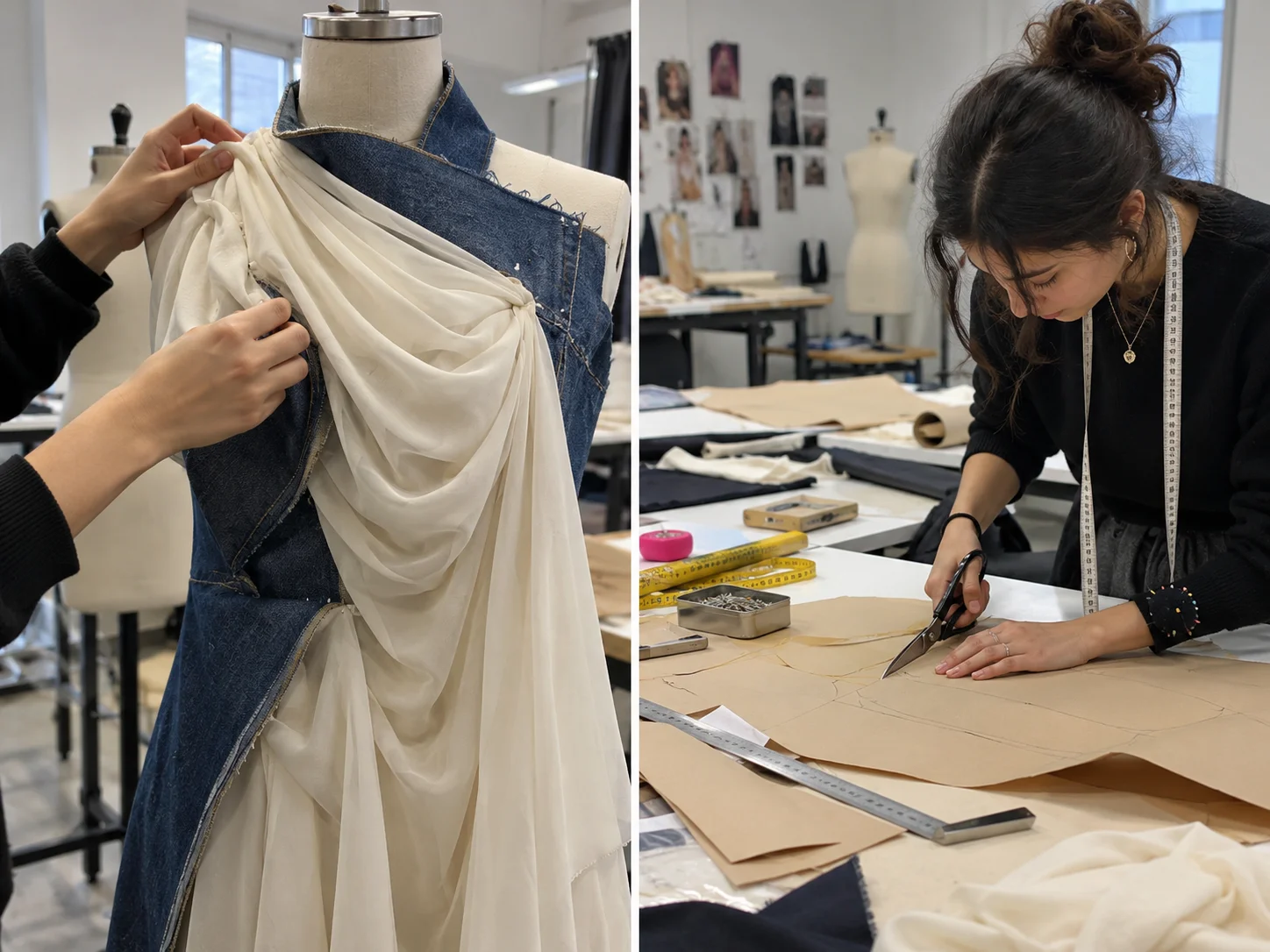
If drawing is not your strongest skill, what else should you focus on?
Fashion designing involves several creative and technical abilities. Understanding these will help you decide whether the field genuinely interests you.
1. Understanding Fabrics
A design that looks attractive on paper may not work equally well with every fabric.
For example, imagine designing a long, flowing dress.
A lightweight fabric may create a soft, flowing appearance, while a stiff fabric may produce a more structured silhouette.
The same design can look and behave differently depending on the material.
As a beginner, start learning about cotton, silk, linen, denim, georgette, and other commonly used fabrics.
Observe how they fall, stretch, fold, and feel.
2. Understanding Colours and Design
You should learn how colours, shapes, proportions, and patterns work together.
Suppose you are designing festive wear for a young customer.
You might experiment with contrasting colours, traditional motifs, and different silhouettes.
Your ability to combine these elements thoughtfully matters even if your first sketches are simple.
3. Basic Pattern Making
Pattern making involves developing the shapes and measurements used to cut fabric and create garments.
For example, designing a shirt requires more than deciding its colour and neckline.
You must also understand how the front, back, sleeves, and collar fit together.
This is where fashion design moves from an idea to a wearable product.
4. Garment Construction
Garment construction helps you understand how clothing is assembled.
Learning basic stitching, seams, finishing, fitting, and alterations can help you design garments that are practical to produce.
You do not necessarily need to be an expert tailor before joining a fashion course.
However, understanding garment construction is valuable for turning your ideas into actual clothing.
5. Creative Thinking and Problem-Solving
Fashion design is not simply about making beautiful clothes.
Designers also solve practical problems.
For example:
- How can a formal outfit remain comfortable during long working hours?
- How can festive clothing be easier to move in?
- How can a garment be designed for different body measurements?
- How can a designer balance appearance, fabric cost, and construction?
These questions require observation, experimentation, and practical thinking.
For beginners, the most useful combination is curiosity, willingness to practise, and an interest in how clothes are designed and made.
Can You Learn Fashion Designing Without Drawing by Using Digital Tools?
Yes, digital tools can help you create and refine fashion designs, but they do not completely replace the need to understand basic garment shapes and design principles.
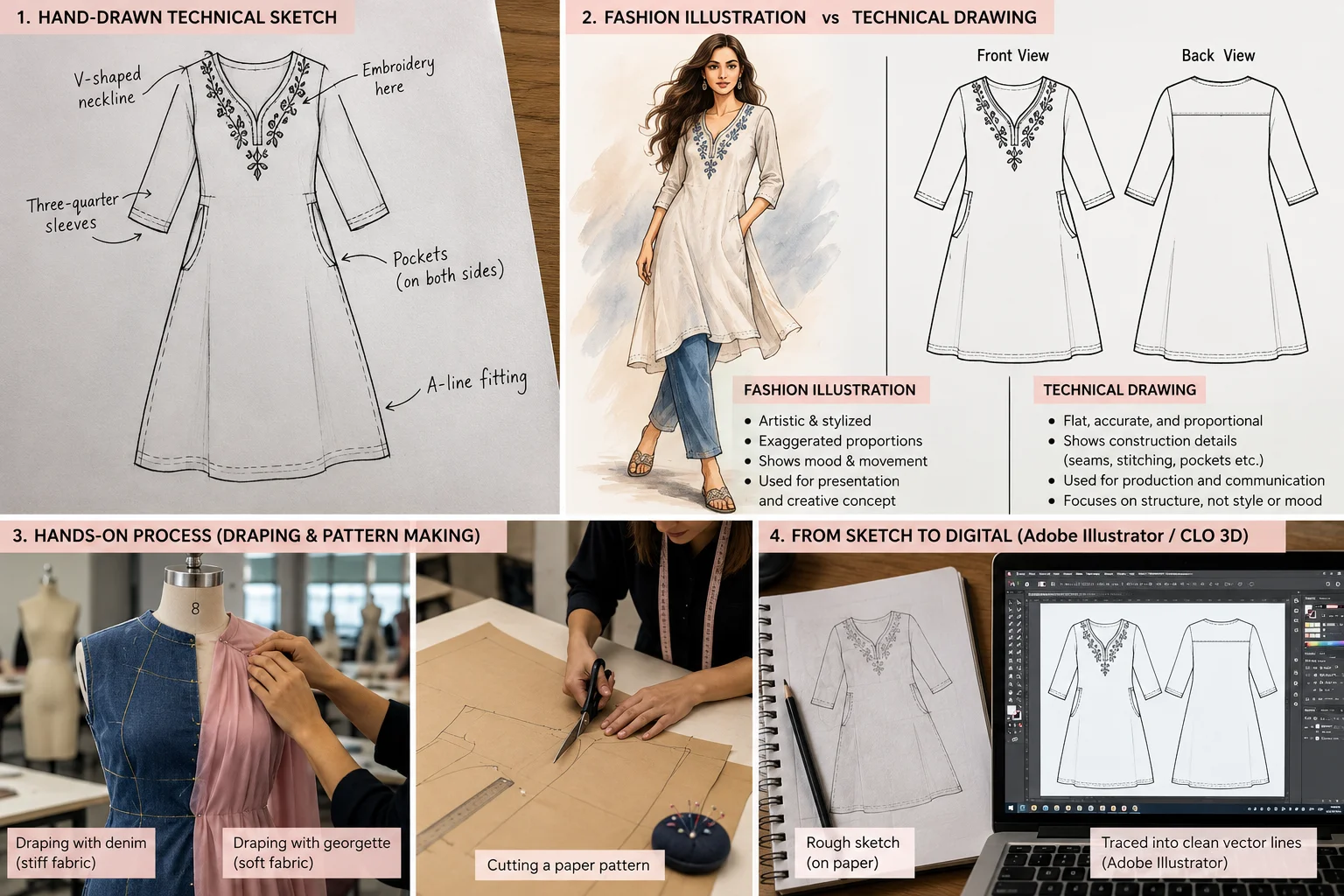
Fashion design software can help with technical drawings, colour combinations, fabric patterns, and visual presentations.
Some tools used in fashion education and professional design work include:
In fact, if you have never designed clothing before, buying expensive software immediately may not be useful.
Start by understanding basic garment shapes and proportions. Then explore digital tools according to the type of work you want to pursue.
Important: Knowing how to operate software does not automatically make someone a fashion designer. You still need to understand fabrics, construction, fitting, and the purpose behind your designs.
How Can Beginners Learn Fashion Sketching From Scratch?
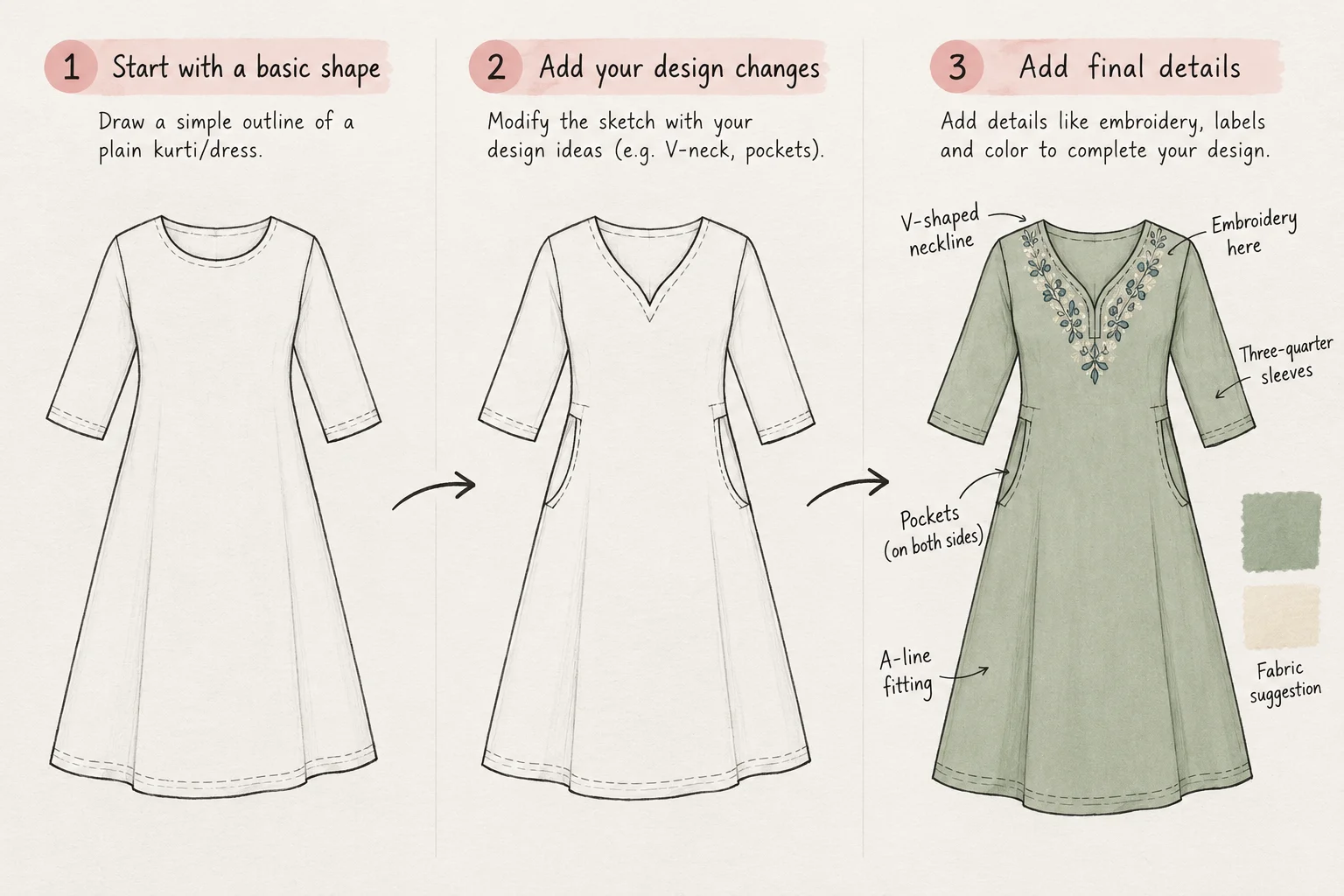
You don't need expensive art supplies or months of preparation.
Start with a pencil, paper, an eraser, and one simple garment.
Here is a practical exercise.
Step 1: Choose a Garment You Already Own
Pick a basic shirt, kurti, skirt, or T-shirt.
Place it on a flat surface.
Observe the neckline, sleeves, overall shape, and stitching details.
Step 2: Draw Only the Garment Outline
Don't begin by drawing a human model.
Try sketching the garment as if it were laid flat.
Use straight lines and simple curves.
At this stage, accuracy matters more than artistic presentation.
Step 3: Add the Important Details
Include elements such as buttons, collars, pockets, sleeve lengths, and seams.
Label anything that is difficult to draw.
For example, you can write "embroidered neckline" next to the relevant section.
Step 4: Create One Variation
Now change something about the garment.
You could:
- Change a round neckline to a V-neck
- Add pockets to a kurti
- Shorten the sleeves
- Change the overall length
- Experiment with a different colour combination
This is your first simple design exercise.
Step 5: Compare Your Design With the Original
Ask yourself:
Does my drawing show what I wanted to change?
Would another person understand the design?
Which details were difficult to represent?
Repeat this activity with different garments.
You are not trying to produce a perfect fashion illustration immediately. You are learning to observe garments and translate ideas into understandable drawings.
A 7-Day Fashion Design Practice Plan for Complete Beginners
If you still aren't sure whether fashion design is right for you, try this small experiment before enrolling in a course.
At the end of seven days, ask yourself three questions:
- Did I enjoy developing clothing ideas, even when my sketches were imperfect?
- Am I interested in learning how garments are actually made?
- Am I willing to practise skills that feel difficult at first?
If your answers are mostly yes, fashion designing may be worth exploring through a structured beginner course.
If you enjoy styling finished outfits but have little interest in designing or constructing garments, you might also want to explore fashion styling.
Neither preference is wrong. They simply point towards different types of work.
Can a Commerce, Science, or Arts Student Learn Fashion Designing?
Yes. Students from Commerce, Science, and Arts backgrounds can pursue many fashion design courses after Class 12, subject to the eligibility criteria of the particular institute or programme.
You do not necessarily need to study Fine Arts in school.
Consider this example.
Scenario: A Commerce Student Who Loves Fashion but Cannot Sketch
Suppose you have completed Class 12 in Commerce.
You enjoy selecting outfits, experimenting with colours, and following clothing trends.
However, you have never studied drawing or garment construction.
Your first question may be:
"Should I take drawing classes before applying for a fashion design course?"
Not necessarily.
A beginner-oriented course that teaches basic sketching, design principles, fabrics, and garment construction may be more useful than spending months learning general artistic drawing alone.
Before applying, ask whether the course assumes previous drawing experience.
Also ask how students are introduced to fashion illustration and practical garment-making.
The same approach applies to students from Science and Arts backgrounds.
Your school stream does not by itself determine your ability to learn fashion design. Specific admission requirements depend on the course and institute you choose.
Which Fashion Design Course Should You Choose if You Cannot Draw?
The right course depends on your current skill level, career goal, available time, and desired qualification.
A longer course is not automatically better for every student.
Use this comparison as a starting point.
Before choosing, remember that a certificate, diploma, and degree are not interchangeable qualifications.
Their recognition, academic level, admission criteria, and suitability for future study can differ.
Choose the course based on what you will learn and what qualification you need, not simply its duration or name.
For a broader comparison, read: Fashion Design Courses in Ahmedabad: Fees, Duration & Eligibility (2026 Guide).
5 Mistakes Beginners Should Avoid
1. Waiting Until You Can Draw Perfectly
If you keep postponing fashion education until your sketches look professional, you may never begin.
Start with simple garment drawings and improve through structured practice.
2. Choosing a Course Only Because It Teaches Fashion Illustration
Sketching matters, but it is not the entire profession.
Review whether the curriculum also includes fabrics, patterns, garment construction, design development, and practical projects.
3. Assuming Fashion Designing Is the Same as Fashion Styling
A fashion designer develops clothing and fashion products.
A fashion stylist generally works with existing garments to create particular looks or presentations.
There can be overlap, but the skills and responsibilities differ.
Understand which work interests you before enrolling.
4. Depending Entirely on AI or Design Software
Digital tools can speed up visual experimentation.
But a generated clothing image does not tell you everything about fit, measurements, fabric behaviour, or construction.
Use technology to support your design process, not as a substitute for learning its fundamentals.
5. Joining Without Reviewing Actual Student Work
Course brochures can look attractive, but they may not show what beginners actually achieve during training.
Ask to see examples of student sketches, patterns, finished garments, and design portfolios.
Where possible, compare early-stage student work with later projects.
This can help you understand the learning process more realistically.
7 Questions to Ask Before Joining a Fashion Design Institute
If you cannot draw and are considering a fashion design course, use this checklist when speaking to the admissions team.
- Does the course teach drawing from the basics? Find out whether students with no art background receive introductory training.
- How much practical garment-making is included? Ask about pattern making, stitching, fitting, and finished garment projects.
- Will I learn both manual and digital design techniques? Check the actual curriculum rather than assuming every software tool is included.
- Can I see work created by beginner students? Look for evidence of progressive learning.
- How is student work evaluated? Ask whether assessments involve sketches, garments, portfolios, written work, or a combination.
- What qualification will I receive? Confirm the awarding institution, programme recognition, and whether the qualification meets your future academic or professional needs.
- What is the complete course cost? Check tuition, materials, software, examination charges, and any additional expenses.
You should also ask about batch schedules and the amount of supervised practice available.
An institute's ability to explain its teaching process clearly is more useful than a general promise that anyone can become a designer.
How Can You Start Learning Fashion Designing at Amor Design Institute?
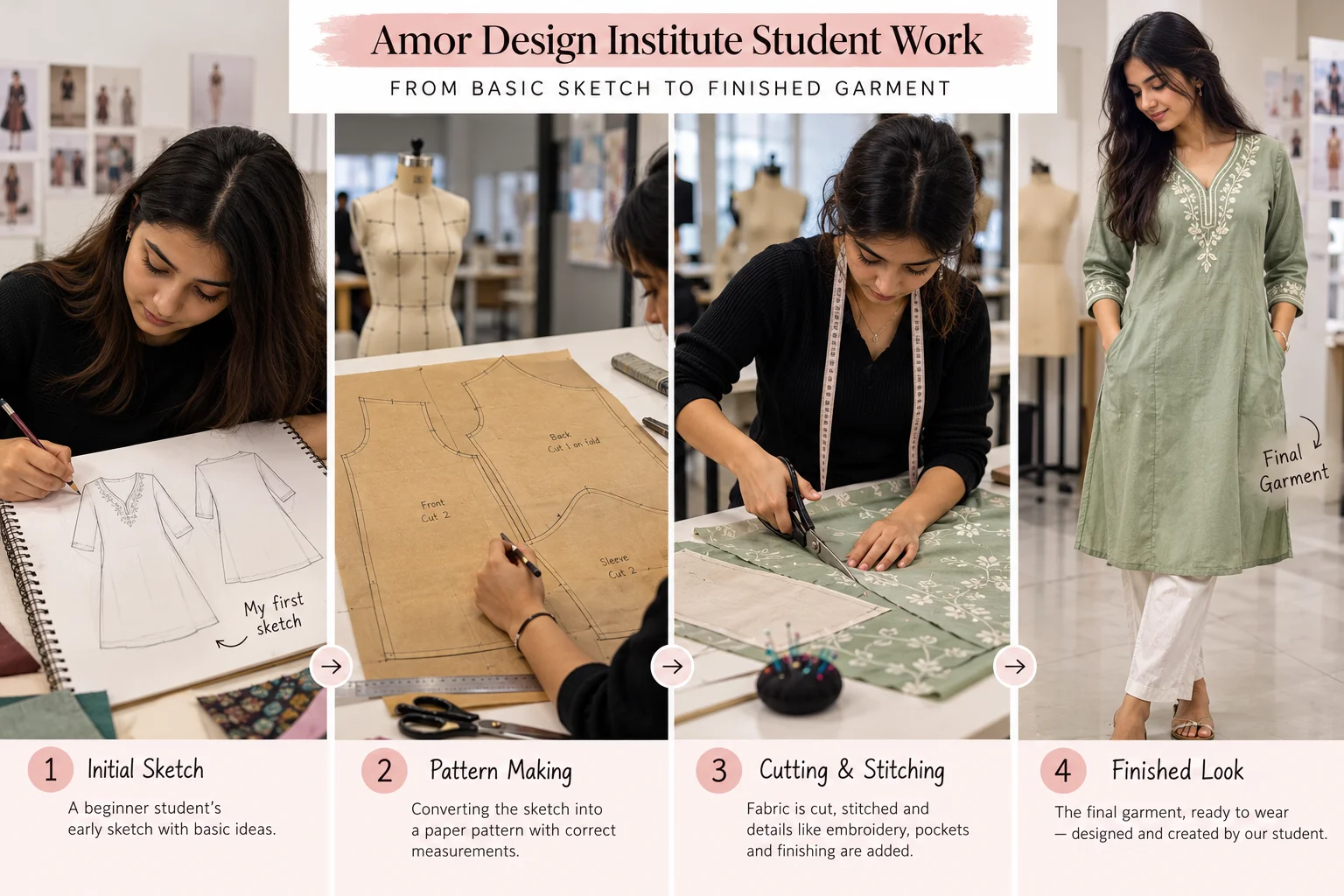
If you are based in Ahmedabad and want structured fashion design training, you can explore the programmes offered by Amor Design Institute.
According to Amor's published Fashion Design Course page, the curriculum begins with subjects such as:
- Elements and principles of design
- Colour theory
- Basic sketching and design process
- Fabric science
- Fashion model drawing
- Pattern making and garment construction
- Surface ornamentation
The published curriculum also includes fashion illustration and digital design-related learning in subsequent course stages.
This is relevant if you are a beginner because the curriculum identifies basic sketching as a foundation rather than focusing exclusively on advanced illustration.
Amor lists fashion design programmes of different durations, including 6-month, 1-year, and 2-year options, along with longer programmes.
However, you should confirm the current curriculum, eligibility, fees, availability, and qualification details directly with the institute before applying.
What Should You Ask Amor Before Enrolling?
If drawing is your biggest concern, you can ask the admissions team:
"I am interested in fashion designing but have no drawing experience. Does your course start with basic sketching? Can I see some beginner-level assignments and understand how drawing skills are developed throughout the programme?"
You can also request details about practical garment-making projects and portfolio preparation.
This will help you make a more informed decision than choosing a course based on promotional information alone.
Explore: Fashion Design Courses at Amor Design Institute.
What Career Options Can You Explore if Drawing Is Not Your Strongest Skill?
Fashion includes different types of work, and each role places different demands on drawing, technical skills, and visual communication.
These are broad role descriptions, not guarantees that a particular course will qualify you for each job.
Also, choosing a role that requires less drawing does not mean it requires less training.
For example, pattern making involves technical precision, while merchandising requires commercial and product knowledge.
If your goal is specifically to become a clothing designer, learning basic drawing and visual communication remains worthwhile.
Frequently Asked Questions
1. Can I become a fashion designer if I am bad at drawing?
Yes. Poor drawing skills do not automatically prevent you from learning fashion design. You can begin with basic garment sketches and develop your abilities through practice. However, you should be prepared to learn visual communication and technical design skills.
2. Do I need to know sketching before joining a fashion design course?
Not always. Many beginner-oriented courses introduce sketching as part of the curriculum. However, admission requirements differ, so confirm whether your chosen programme expects previous drawing experience or a portfolio.
3. Is fashion designing difficult for beginners?
Some subjects, particularly fashion illustration, pattern making, and garment construction, may initially feel challenging. Beginners can make progress by learning basic concepts, practising regularly, and completing practical assignments.
4. Can I learn fashion designing without knowing how to stitch?
Yes, you can begin without prior stitching experience. However, garment construction is an important part of understanding how clothing is made. A comprehensive fashion design education will usually involve learning at least the fundamentals.
5. Can I become a fashion designer without taking Fine Arts in school?
Yes. Fine Arts is not a universal requirement for fashion design education. Many programmes admit students from different academic streams, although individual institutes and degree programmes may have specific eligibility or entrance requirements.
6. Can I use software instead of drawing by hand?
Software can help you produce fashion illustrations and technical designs. However, basic sketching, garment knowledge, and visual understanding remain valuable. Learning both manual and digital techniques can be useful.
7. What should I learn first as a beginner in fashion designing?
Start with garment observation, basic sketching, colour theory, and fabric identification. Then gradually explore pattern making, stitching, fashion illustration, and digital design tools.
8. Can I pursue fashion designing after Class 12 Commerce?
Yes, many fashion design courses accept students from Commerce backgrounds. Check the eligibility of the particular certificate, diploma, or degree programme before applying.
9. Is drawing more important than creativity in fashion designing?
Both serve different purposes. Creative thinking helps you develop ideas, while drawing helps communicate them. A workable design also requires technical knowledge, including fabric selection, fitting, and construction.
10. How long does it take to learn fashion sketching?
There is no fixed timeline. Progress depends on your starting point, practice frequency, the complexity of the drawings, and the training you receive. Begin with simple garment sketches and assess your improvement over several weeks rather than expecting immediate professional results.
Final Thoughts: Don't Let Drawing Stop You From Exploring Fashion Design
You do not have to be an excellent artist to begin learning fashion design.
What matters is whether you enjoy developing clothing ideas, understanding fabrics, solving design problems, and learning how garments are made.
Drawing is one of the tools that helps you communicate those ideas. It is a skill you can improve rather than a talent you must already possess.
Before making a decision, try the seven-day beginner exercise, explore the different areas of fashion, and review the curriculum of any institute you are considering.
If you are looking for a beginner-friendly learning pathway in Ahmedabad, you can explore Amor Design Institute's fashion design courses and speak with the admissions team about the appropriate starting level.
Your first fashion sketch does not need to be perfect. It only needs to be a starting point.
Credibility references
The article's explanations of fashion flats, illustration, and design education are supported by the following resources:
- Bharat Skills — Fashion Design & Technology: Technical flat drawing and fashion design fundamentals.
- SWAYAM — Apparel Designing: Drawing, draping, fashion design processes, and computer-aided design.
- Amor Design Institute — Official Course Curriculum: Amor's published modules and course durations.