Introduction
Ask any Indian man what he reaches for on a wedding day, and you will get a different answer depending on his state, his community, and his grandfather's stories. A Gujarati groom drapes a pachedi. A Rajasthani man reaches for an angarkha with a safa tied in careful layers. A Bengali bridegroom won't be caught without his dhoti and punjabi. Traditional men's wear in India is not a single story, it is thousands of them, stitched across centuries and passed down through generations.
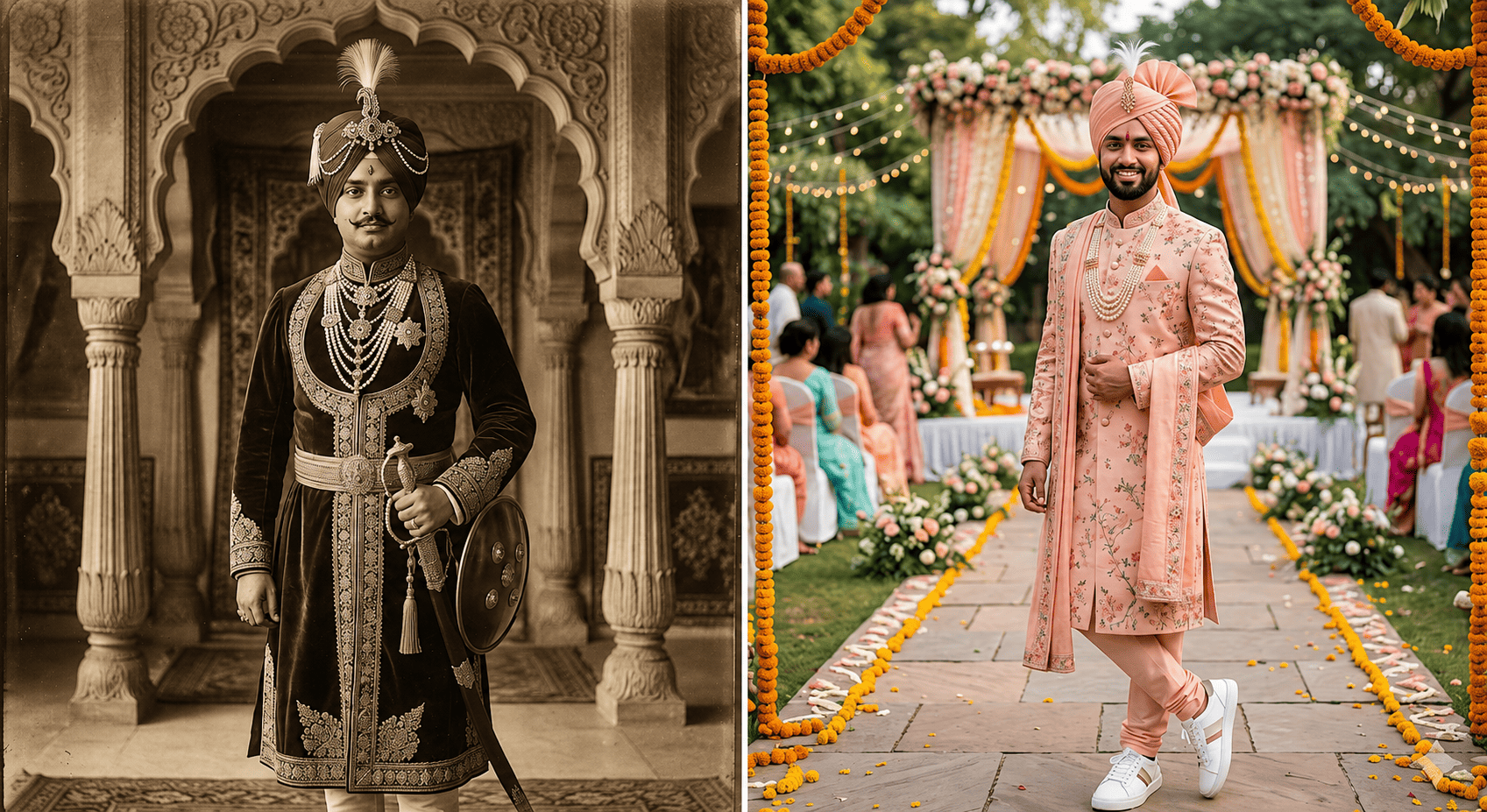
But here is what is remarkable: in 2025, those same garments are walking fashion weeks in London, Delhi, and New York. The sherwani is no longer reserved for weddings. The bandhgala is being paired with chunky sneakers. Linen kurtas are showing up to board meetings. Something quietly profound is happening to Indian ethnic wear for men and it starts with understanding where these clothes actually came from.
The History of Indian men's wear
A Civilization Dressed in Cloth
The history of traditional men's wear in India is inseparable from the history of India itself. It has been shaped by climate, trade routes, royal courts, invasions, and centuries of layered cultural exchange. What we call "traditional" today was, at its origin, often a radical innovation for its time.
The story begins over five thousand years ago in the Indus Valley, where the earliest evidence of draped cloth appears to be unsewn fabric worn around the waist and shoulders. Priests and merchants in Mohenjo-daro were depicted in simple wrapped garments. India's relationship with unstitched fabric, one that would define its textile identity for millennia, quietly begins here.
The Dhoti : Oldest Living Garment
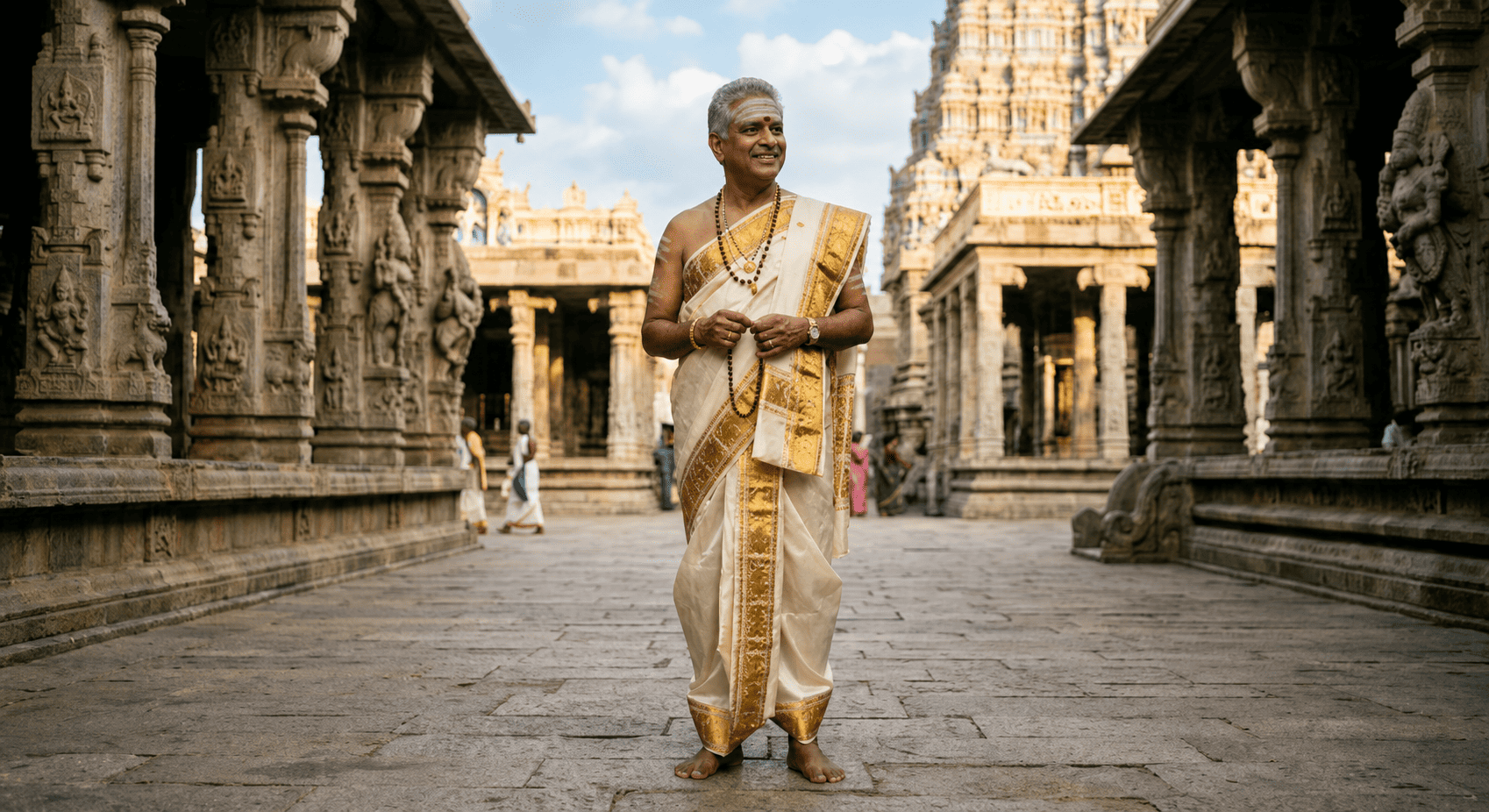
By the Vedic period, the dhoti had emerged as the dominant garment for men across regions and castes. A single unsewn cloth typically five yards of cotton or silk draped and tucked at the waist in styles that varied by geography. The Nivi drape, the Kacha style, the Pancha each regional variation told you something about where a man came from, what work he did, and which deity he worshipped. The upper cloth, called the uttariya, completed the ensemble.
What makes the dhoti extraordinary is its survival. It has not been preserved in a museum. It is worn today by priests during rituals, by farmers in Tamil Nadu, by politicians on Republic Day, and increasingly by young designers making a cultural statement.
The Mughal Revolution : When Stitching Changed Everything
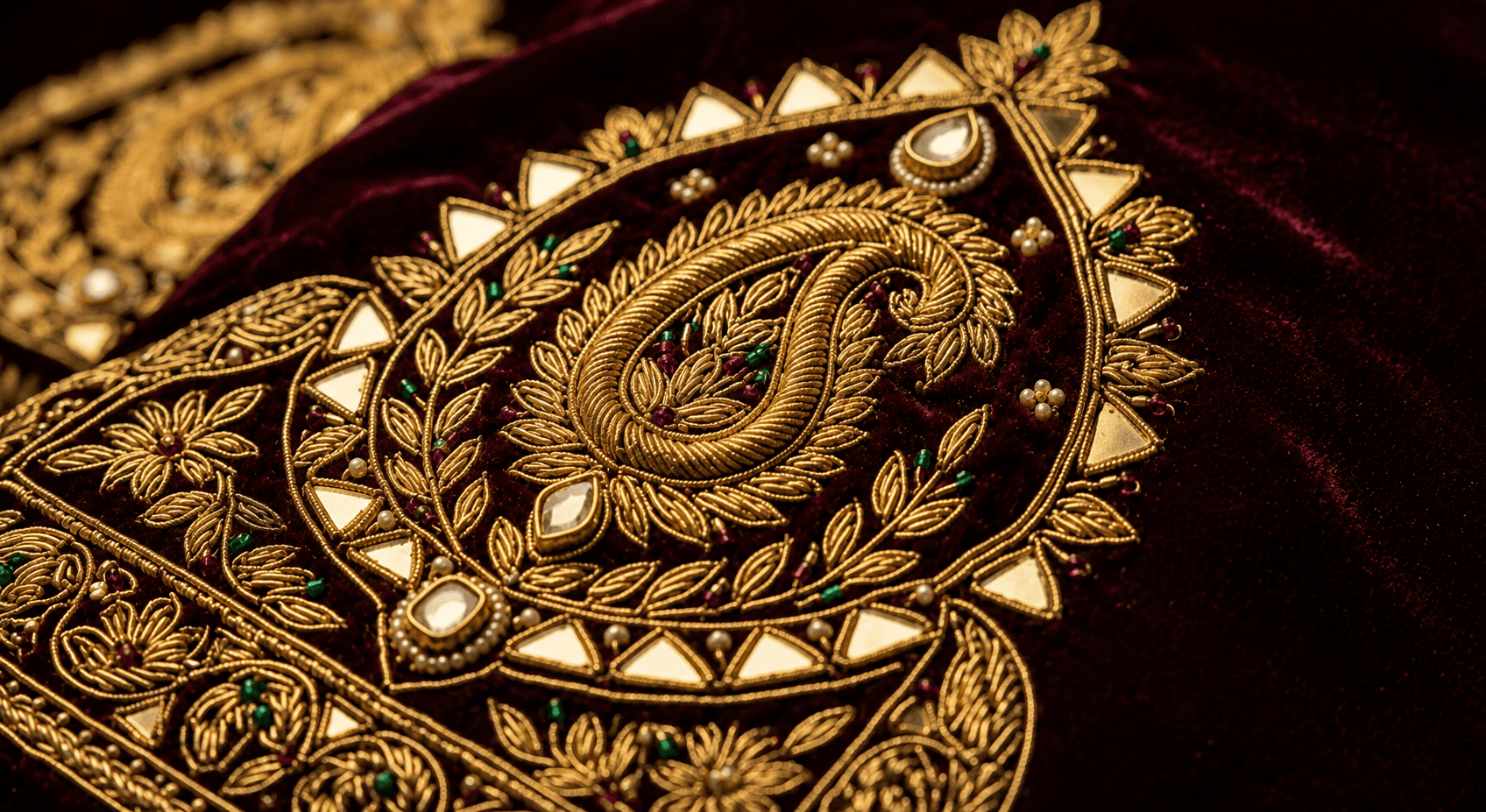
The arrival and rule of the Mughal Empire between 1526 and the mid-1800s transformed Indian dress in ways that are still visible today. Persian tailoring met Indian textiles, and the result was nothing short of spectacular.
The jama, a full-skirted coat tied at the waist, became the uniform of Mughal courts. The angarkha, with its wrapped front and asymmetric ties, was worn by nobles and commoners alike. Embroidery evolved into high art: zardozi, gota patti, and zari work turned garments into wearable architecture. The seeds of what would eventually become the sherwani were planted in this era.
Crucially, stitched garments gained social legitimacy alongside the draped ones. India stopped being purely a civilization of wrapped cloth and became one of the most sophisticated textile cultures on earth.
The Kurta : A Tunic That Conquered India
The kurta, derived from Persian influence and adapted across every corner of the subcontinent, became the most democratic garment in Indian men's wear history. Long and collarless, it sat over churidars, pyjamas, dhotis, and later trousers. Every region put its own stamp on it: the chikan embroidery of Lucknow, the mirror work of Kutch, the block prints of Rajasthan.
The kurta did not belong to any one religion, caste, or class. It was worn by the Mughal emperor and the village weaver. That universality is what has allowed it to survive and thrive into the 21st century.
The Sherwani and Bandhgala Formality, Reimagined
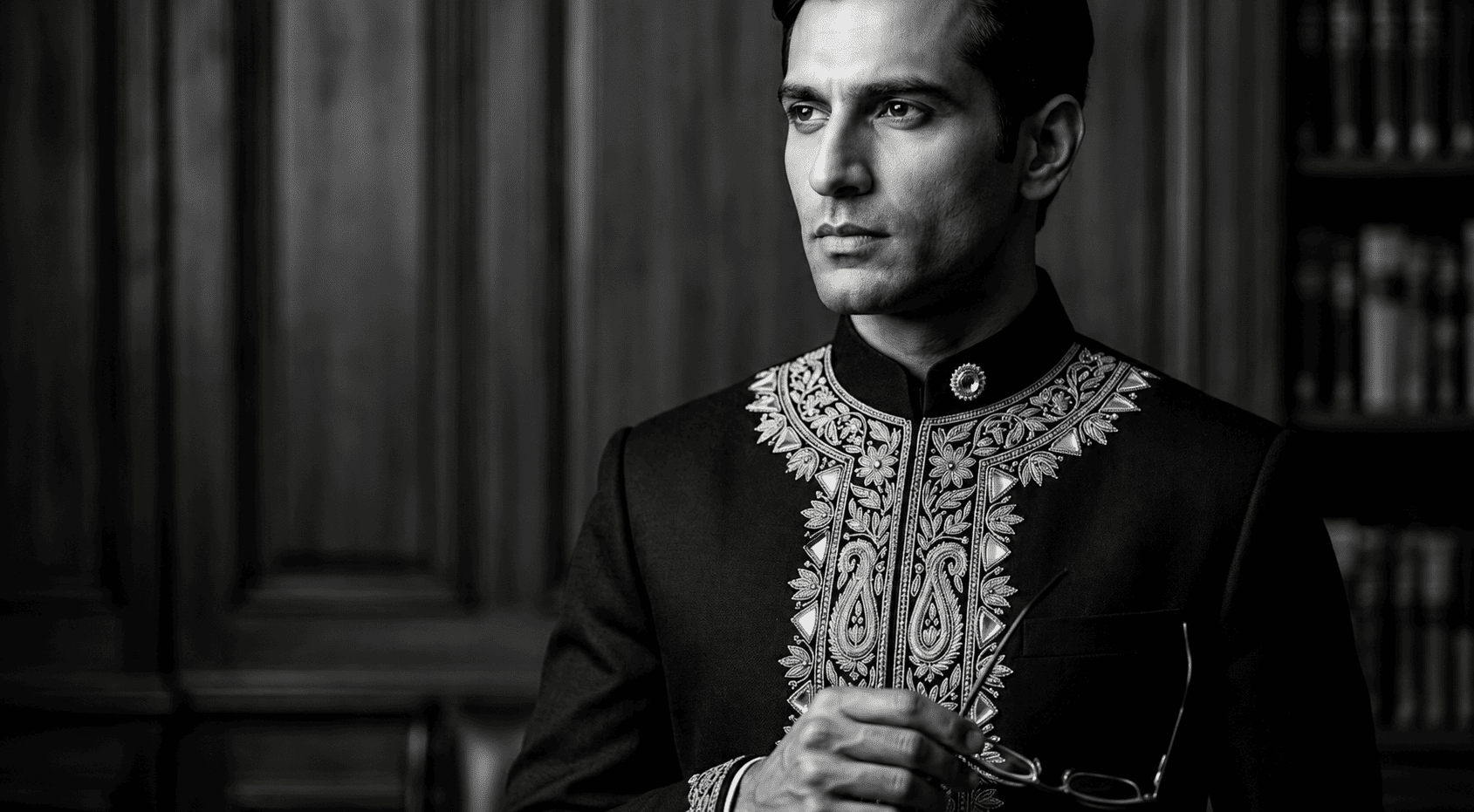
The sherwani, a long structured coat worn over a kurta and churidar, emerged as the definitive formal garment for Muslim men in North India during the 18th and 19th centuries. By the time of the princely states, it had become the official dress of aristocracy embellished, structured, and unmistakably powerful.
The bandhgala, also known as the Nehru jacket, developed during the colonial era as an Indian response to the Western suit. Its closed mandarin collar and tailored structure said: we can be formal without imitating you. Jawaharlal Nehru wore it so consistently that it became synonymous with Indian statesmanship. It remains, to this day, one of the most internationally recognizable pieces of Indian men's wear.
Modern Styling How Indian men's wear Is Being Reimagined
The Shift That Changed Everything
Something significant began happening to Indian ethnic wear for men around 2015 and has only accelerated since. A new generation of designers, stylists, and conscious consumers started asking a question that had no clean answer before: why does traditional Indian clothing only come out for weddings and festivals?
The answer was never that the garments were unsuitable for everyday life. It was that no one had seriously styled them for it. That gap is now being filled and the results are reshaping what modern Indian ethnic wear means.
Asymmetric Kurtas Breaking the Old Silhouette
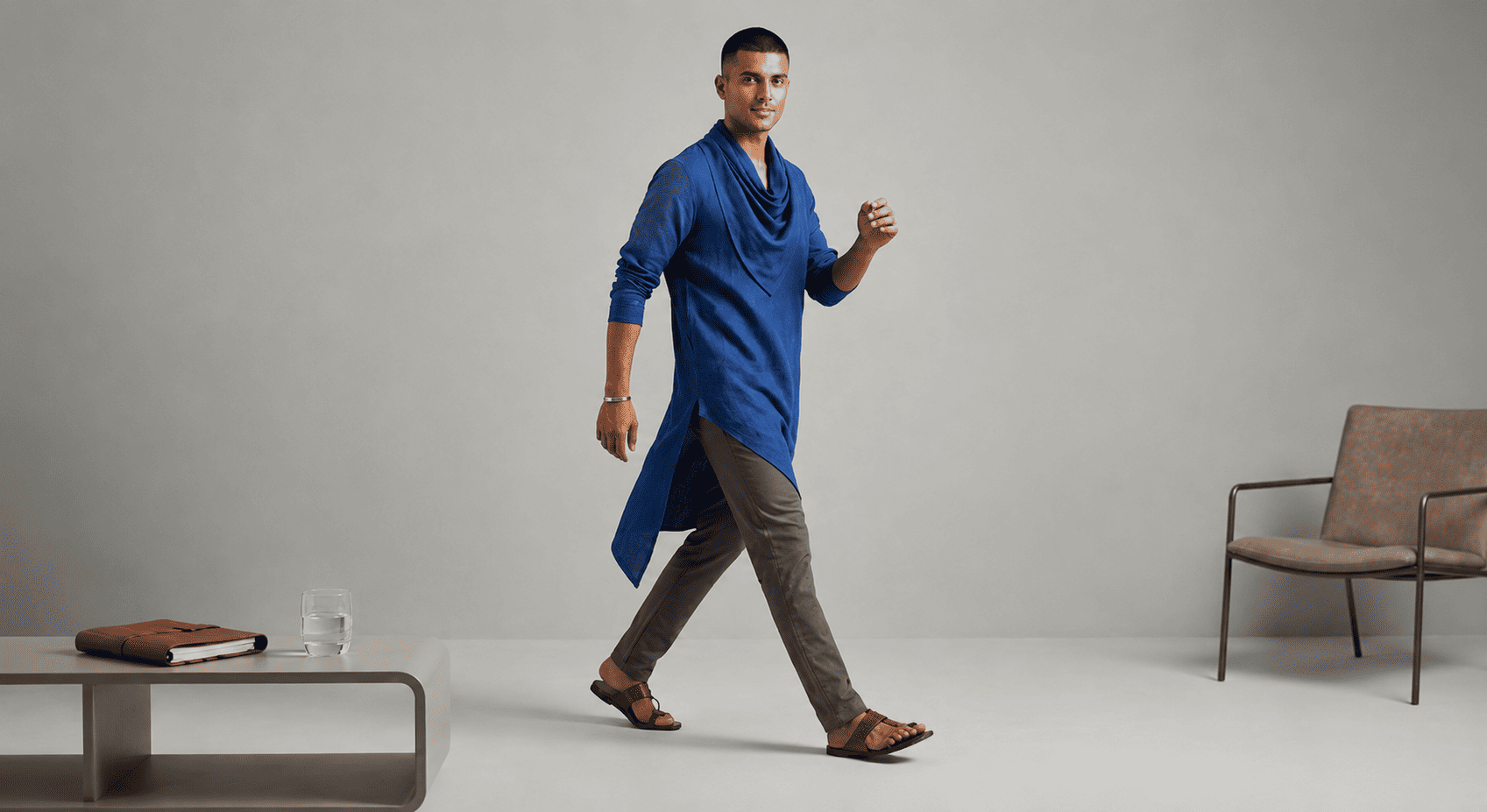
The traditional kurta was, for most of its history, a symmetrical garment. Same length all around, same weight on both sides. Contemporary designers like Tarun Tahiliani, Antar-Agni, and a growing wave of independent labels have blown that silhouette apart.
Asymmetric hemlines that drop lower on one side. Diagonal cuts across the chest. Layered plackets that create visual movement. These are not gimmicks, they are genuine design evolutions that make the kurta feel alive and modern without stripping it of its identity. An asymmetric linen kurta worn with slim trousers and white sneakers is not a compromise between Indian and Western dressing. It is something entirely new and entirely Indian.
Sneakers With Sherwanis : The Styling Rule No One Follows Anymore

A few years ago, pairing sneakers with a sherwani would have been considered fashion sacrilege. Today, it is one of the defining style moves of the modern Indian groom and the fashion-forward young man at a sangeet.
It works because the visual contrast is deliberate and confident. A cream sherwani with a heavily embroidered yoke, worn over a slim churidar, grounded by clean white Nikes, this combination reads as someone who knows the tradition well enough to play with it. Bollywood has accelerated this shift, with actors like Ranveer Singh and Vicky Kaushal normalizing the aesthetic at red carpets and film events.
The key to making this work is proportion. The sherwani should be slim and well-tailored, not boxy. The sneaker should be clean and minimal. The two extremes ornate embroidery and unadorned footwear need each other to make sense.
Pastel Palettes for the Modern Groom
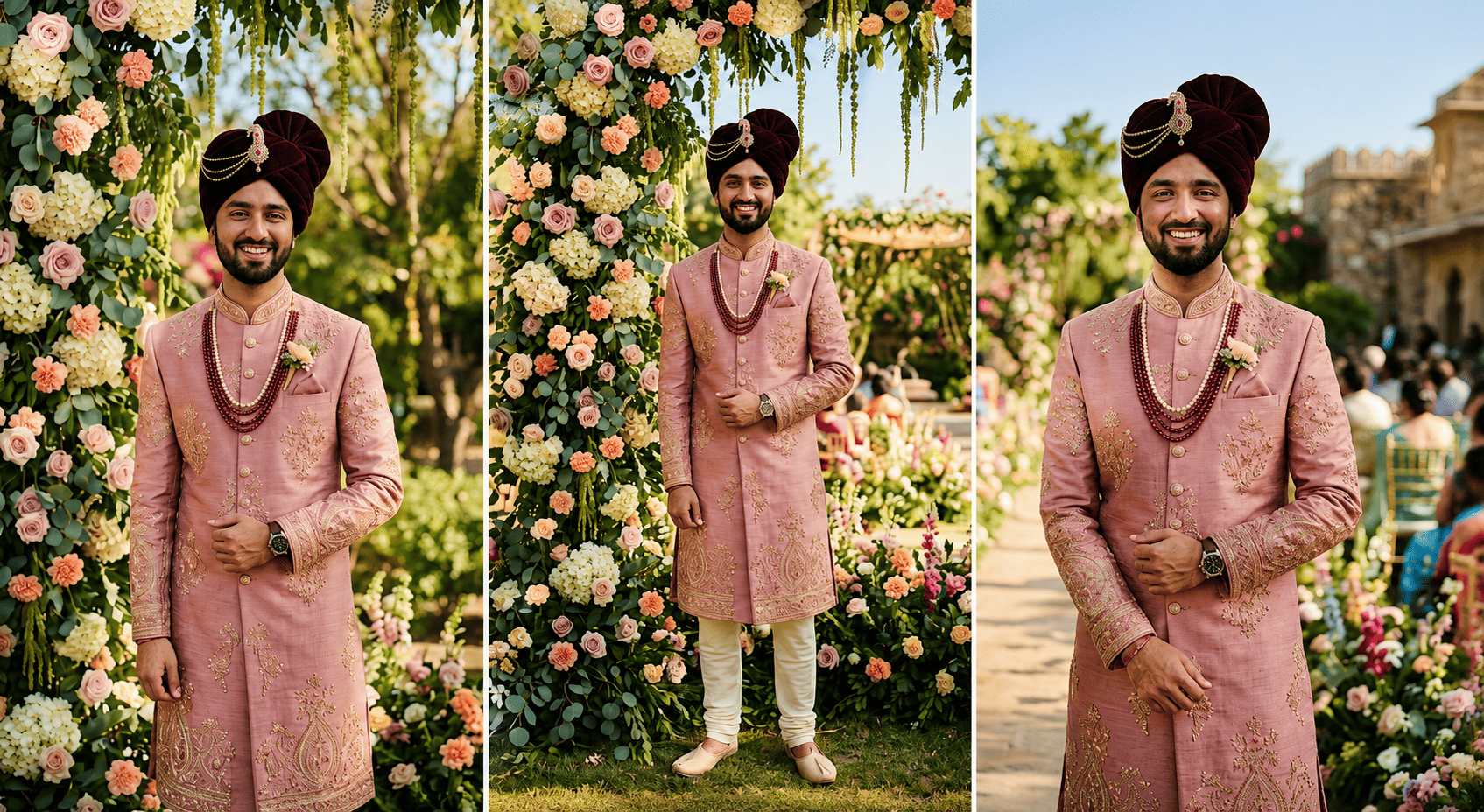
For decades, Indian bridal men's wear was dominated by three colors: red, gold, and ivory. These remain beautiful and deeply meaningful. But the modern groom is increasingly reaching for something different.
Dusty rose. Sage green. Powder blue. Lavender. Warm beige. These pastel palettes have moved from bridalwear runways into mainstream wedding dressing, driven partly by the popularity of destination weddings and intimate ceremonies where a full brocade sherwani in crimson can feel overpowering.
A mint green bandhgala with ivory churidar and a contrast pocket square. A blush pink sherwani with matte gold embroidery and champagne mojris. These combinations feel personal, photogenic, and deeply contemporary without abandoning the structure and craft of traditional styling Indian clothes for men.
Modern Draping : The Dhoti Comes Back
Perhaps the most exciting development in contemporary Indian men's wear is the serious revival of draping. The dhoti, once written off as costume or kitsch outside religious contexts, is being rethought from the ground up.
Designers like Gaurav Gupta and Raw Mango have presented dhoti trousers pre-draped, tailored versions that offer the visual drama of the traditional dhoti with the practicality of a pair of pants. On the street, young men are experimenting with self-draping: cotton dhotis worn with plain white tees and kolhapuris, or silk dhotis worn with structured jackets for evening occasions.
This is not nostalgia. It is confidence in a generation that has made peace with its inheritance and is dressing accordingly.
Fabrics Doing the Heavy Lifting
Modern styling of Indian ethnic wear is as much about fabric choice as it is about silhouette. Linen has become the fabric of choice for the kurta-wearing professional breathable, unpretentious, and increasingly available in nuanced natural dyes. Handlooms from Pochampally, Maheshwar, and Chanderi are being chosen not because they are traditional but because they are beautiful and sustainable.
The growing khadi revival deserves its own mention. What Gandhi turned into political symbolism, a new generation of wearers is embracing as an aesthetic and ethical choice. Rough-woven khadi kurtas, often left with natural irregularities, have become a mark of considered, conscious dressing.
The Office Equation

One of the most practical frontiers of modern Indian ethnic wear for men is the workplace. For too long, the equation in Indian offices defaulted to Western formal wear suits, button-downs, and leather shoes. That is changing, particularly in creative industries, startups, and family businesses where the dress code is self-authored.
A well-fitted linen kurta in a neutral tone, worn with slim tailored trousers and loafers, is as professional as any dress shirt. A bandhgala jacket worn over a plain kurta is sharper than most blazers. The shift requires only one thing: conviction. Men who wear Indian ethnic wear to professional settings with ease and confidence are making a statement that resonates far beyond fashion.
From Wearing to Creating
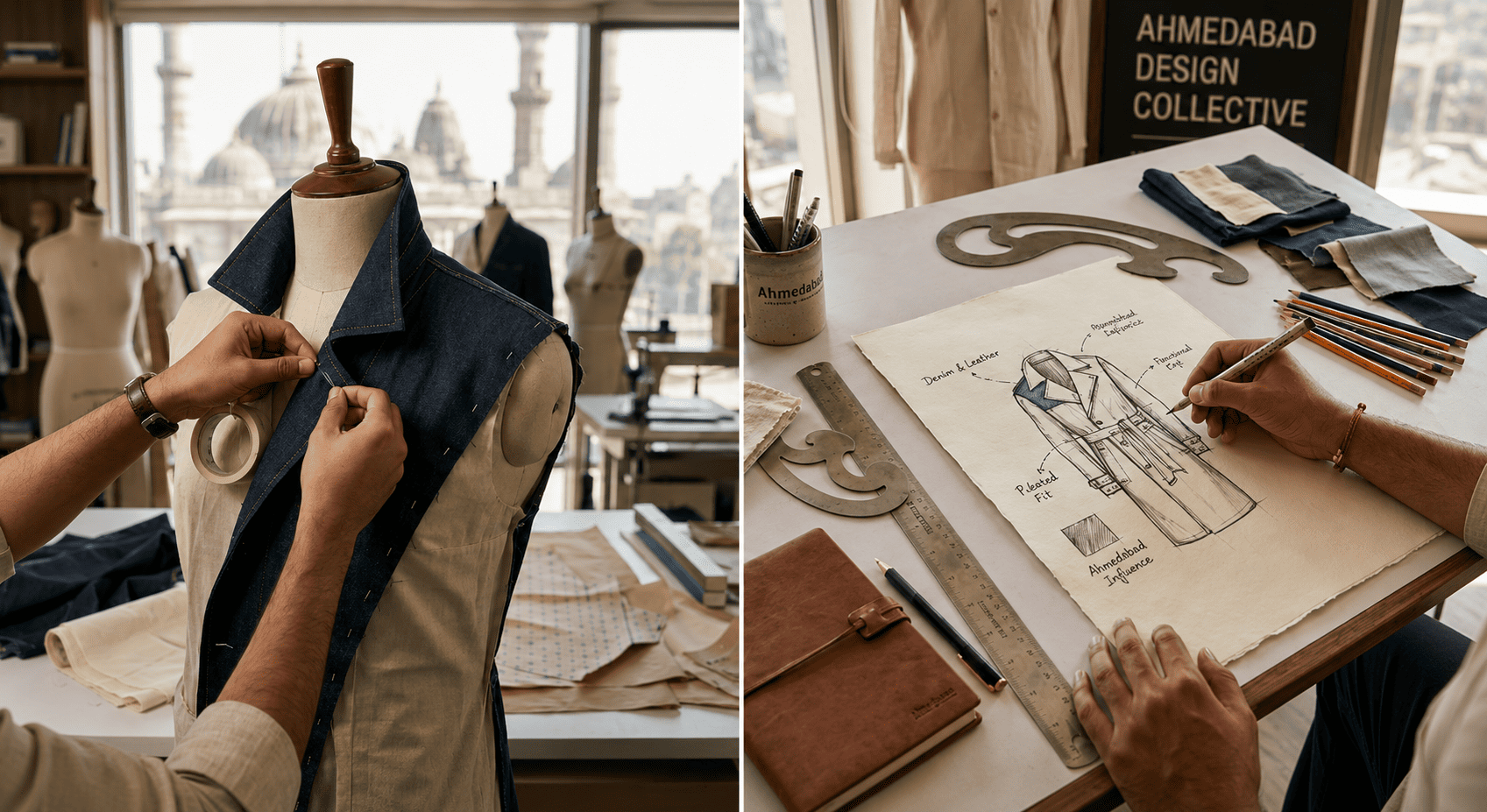
Mastering the balance between historical silhouettes and modern draping techniques is what separates good designers from great ones. Understanding why an asymmetric kurta works, how a dhoti drape changes proportion, or what makes a pastel bandhgala feel current rather than costume these are not instincts. They are skills, built through structured learning and hands-on practice.
If you are passionate about men's wear and want to learn the technical skills to create your own ethnic collections, explore the curriculum of our fashion designing course in Ahmedabad. From pattern drafting to draping techniques to styling for the modern Indian man, the program is built for those who want to shape what Indian fashion looks like next.
Conclusion
Traditional men's wear in India has never been a fixed thing. The dhoti evolved. The kurta adapted. The sherwani absorbed influences from three continents and emerged distinctly Indian. The bandhgala answered a colonial moment with quiet dignity.
What is happening today, the asymmetric cuts, the sneakers, the pastels, the handloom revival, is not the erosion of tradition. It is the continuation of it. Every generation of Indian men has styled their inheritance in the language of their own time. Ours is doing the same.
The clothes are ancient. The conversation is just beginning.
Key Takeaways
- Indian men's wear has a 5,000-year history rooted in draped, unsewn cloth, the dhoti being one of the oldest continuously worn garments on earth.
- The Mughal era was transformative; it introduced Persian tailoring, structured stitched garments, and elevated embroidery into a defining feature of Indian men's wear.
- The kurta, sherwani, dhoti, and bandhgala are the four foundational pillars of traditional Indian ethnic wear for men, each with a distinct historical origin and regional variation.
- Modern Indian ethnic wear is defined by contrast pairing sneakers with sherwanis, wearing pastels instead of reds and golds, and choosing asymmetric silhouettes over traditional ones.
- Fabric is a styling decision. Linen, handloom, and khadi are not just materials; they communicate values of sustainability, craftsmanship, and cultural identity.
- The dhoti is back. Pre-draped dhoti trousers and self-styled cotton dhotis are being worn by a new generation as an act of cultural confidence, not nostalgia.
- Traditional Indian clothes work in the office. A well-fitted kurta in a neutral linen is as professional as a dress shirt, and a bandhgala can out-sharp most blazers.
The history of Indian men's wear is a history of adaptation every era reimagining the garments of the one before it. Modern styling is simply the latest chapter.