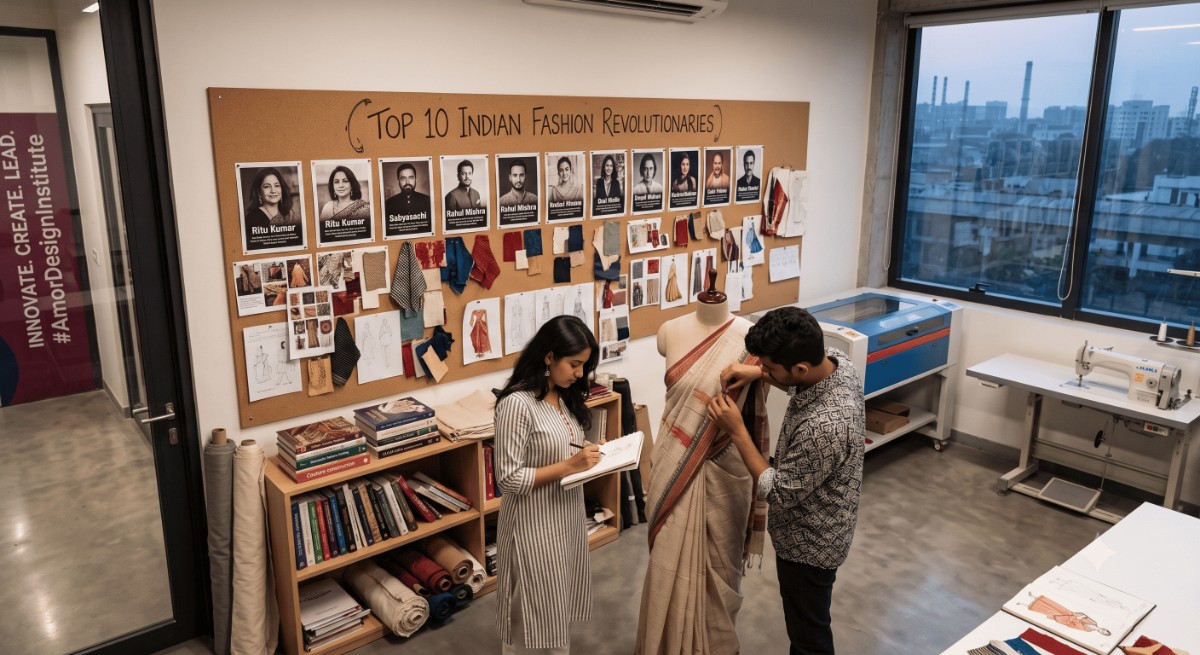
Introduction
Pattern-making is the backbone of fashion design, translating creative ideas into wearable garments. Whether you're just starting in fashion design or looking to enhance your skills, understanding pattern-making is crucial for producing well-fitted and stylish clothing. This blog delves into the fundamentals, techniques, and importance of pattern-making in the apparel industry. If you aspire to learn this craft professionally, enrolling in a fashion design course in Ahmedabad can help you master the art of pattern making.
Table of Contents
- What Is Pattern Making?
- Tools You Actually Need
- Methods of Pattern Making
- Essential Techniques
- Pattern Making in the Apparel Industry
- How to Start Making Your Own Patterns
- Advanced Techniques
- Why Learn Pattern Making?
- Amor Design Institute
- FAQs
The Part of Fashion Design Nobody Talks About Enough
Ask someone what fashion designers do, and they'll describe sketching pencil on paper, beautiful illustrations, creative vision coming to life. What they won't describe is the hours spent translating that sketch into something a human body can actually wear.
That translation is pattern making. And it's not a minor technical step you hand off to someone else, it's a fundamental design skill. The difference between a garment that fits beautifully and one that looks slightly off almost always comes down to the quality of the pattern behind it.
If you're serious about fashion design whether you're just starting out or looking to sharpen skills you already have, this is the area worth understanding properly.
What Is Pattern Making in Fashion Design??

Pattern making is the process of creating templates patterns that are used to cut fabric pieces and assemble them into a finished garment. Think of it as the architectural blueprint between the design sketch and the physical garment.
It's where creativity meets technical precision. A design sketch tells you what something should look like. A pattern tells you exactly how to make every piece of fabric, every seam, every curve, every allowance with enough accuracy that the finished garment matches what the designer intended.
Why Is Pattern Making So Important?
Three reasons that are hard to argue with:
- Fit a well-drafted pattern ensures the garment fits the body accurately, not approximately
- Translation it's the mechanism that turns a 2D sketch into a 3D design that someone can actually wear
- Scalability in mass production, patterns are what allow a garment to be reproduced consistently across thousands of units
Without pattern making, fashion design is just art. With it, design becomes clothing.
The Basics of Pattern Making in Fashion Design

Understanding Fashion Pattern Making
Fashion pattern making combines creativity and technical precision. It begins with a design sketch and evolves into patterns for individual garment pieces.
What Are the Essential Pattern Making Tools?
You don't need a huge toolkit to start but the right tools make the difference between accurate patterns and frustrating ones.
The French curve ruler deserves a special mention. It's one of those tools that looks unnecessarily specific until you try to draw a clean armhole or neckline without one then it becomes indispensable.
What Are the Different Pattern Making Methods?
There are three main approaches, and which one you use depends on the garment, the design, and your working style.
Flat Pattern Drafting

What it is: Drawing patterns from a flat piece of paper using measurements or a pre-made block (also called a sloper, a basic template fitted to specific measurements).
Best for: Basic garment shapes shirts, skirts, trousers, dresses. Any garment with relatively predictable geometry.
Why it matters: It's the most systematic approach, which makes it the most reproducible. Once you have a well-fitted block, you can manipulate it to create almost any variation without starting from scratch every time.
Draping

What it is: Creating patterns by working directly with fabric on a mannequin or dress from pinning, folding, and shaping the fabric until it looks right, then transferring what you've done to paper.
Best for: Flowing, complex, or heavily draped designs where the movement and behaviour of the fabric is part of the design itself.
Why it matters: Some garments simply can't be drafted on paper and then expected to behave correctly on a body. Draping lets the fabric tell you what it wants to do which is sometimes more useful than imposing a mathematical solution on it.
Pattern Grading

What it is: Taking a pattern that's been made for one size and systematically adjusting it to produce a range of sizes larger and smaller while maintaining the original proportions.
Best for: Any production context where a garment needs to be available in multiple sizes.
Why it matters: Grading is what makes fashion inclusive in a practical sense. Done well, it ensures that the garment fits a size 8 and a size 18 with equal care and proportion.
What Are the Core Pattern Making Techniques?

These are the foundational skills, the ones that come up in every pattern, regardless of garment type or complexity.
1. Pattern Drafting
Drawing garment patterns from scratch using specific body measurements. This is where everything starts getting these measurements right is non-negotiable, because every subsequent step is built on them.
2. Seam Allowance
The extra fabric added beyond the pattern's cutting line, which allows pieces to be sewn together without the seam eating into the garment's intended dimensions. Standard seam allowances vary by garment type and construction method knowing which to apply when is a skill developed through practice.
3. Pattern Notches
Small marks cut into the edge of pattern pieces that indicate where pieces should align during assembly. They sound minor. They prevent a huge number of assembly errors.
4. Dart Manipulation
Darts are the sewn folds that shape flat fabric to follow the contours of a body. Understanding where to place them, how deep to make them, and how to move them from one position to another dart manipulation is one of the skills that separates a well-fitted garment from one that sits awkwardly.
How Is Pattern Making Used in Professional Fashion Production?

The role of pattern making shifts depending on whether you're working in couture, ready-to-wear, or mass market but it's central to all three.
In mass production:
Patterns are the engine that makes consistency possible. A brand producing 10,000 units of a single style needs patterns precise enough that every unit comes out correctly and digital pattern making software is increasingly how that precision is achieved at scale.
In couture:
Pattern making is where the extraordinary fit that defines haute couture actually comes from. Every garment is made to the individual client's measurements, which means every pattern is unique.
The role of grading in manufacturing:
Pattern grading is what allows a single design to be produced across a full size range while maintaining the proportions and fit quality of the original. It's the practical foundation of size inclusivity in fashion.
How Do You Make Your Own Sewing Patterns From Scratch?
If you've never made a pattern before, the process feels more intimidating than it is. Here's the honest sequence:
Step 1 Take accurate measurements
Use a measuring tape for precise body dimensions: bust, waist, hips, back length, sleeve length, and any other measurements relevant to your garment. Inaccurate measurements at this stage make everything harder downstream.
Step 2 Start with a sloper
A sloper is a basic, fitted template with no seam allowances and no design details, just the fundamental shape of a garment piece fitted to your measurements. It's your starting point for everything else.
Step 3 Draft on pattern paper
Outline your design onto pattern paper, adding seam allowances and notches as you go. This is where the sloper gets modified into the actual garment design.
Step 4 Test with a muslin mock-up
Before cutting into your actual fabric, sew a version of the garment in inexpensive muslin. This is where you find the problems fit issues, proportion problems, anything that needs adjusting without wasting your real material.
The muslin step is the one beginners most often skip, and the one they most often regret skipping.
What Are the Advanced Techniques Used by Professional Designers?
Once the fundamentals are solid, these are the techniques that separate competent pattern makers from exceptional ones.
Block Development
Creating a library of reusable blocks for different garment types: a fitted bodice block, a trouser block, a sleeve block. Once these are fitted correctly to your measurements or a standard size, they become the starting point for almost any design variation without redrafting from scratch.
Grainline Alignment
The grainline the direction of threads in a woven fabric determines how a garment hangs and moves. Aligning pattern pieces correctly with the fabric grain is what makes the difference between a garment that drapes beautifully and one that twists or pulls unexpectedly.
Digital Pattern Making
CAD (Computer-Aided Design) tools are now standard in professional pattern making, particularly for complex grading and adjustments. Software like Gerber, Lectra, and Optitex allow pattern makers to work with precision and speed that manual methods can't match at scale while still requiring the same underlying knowledge to use effectively.
Examples of Pattern Making in Fashion
1. Couture Designs

Pattern making is vital for high-fashion garments, where fit and precision are paramount.
2. Ready-to-Wear Collections

Standardized patterns allow brands to produce consistent, scalable designs for mass markets.
Is Pattern Making Worth Learning as a Fashion Designer?
Without qualification: yes.
It bridges creativity and execution.
The most original design vision is only as good as its ability to become a real garment. Pattern making is the skill that makes that translation possible.
It opens more career doors.
Proficiency in pattern making creates opportunities in fashion design, tailoring, apparel production, costume design, and technical design roles areas that pure sketching skills don't reach.
It makes you a better designer.
Understanding how garments are constructed changes how you design them. Designers who know pattern making make choices about seam placement, silhouette, proportion that designers without that knowledge simply can't.
How Does Amor Design Institute Teach Pattern Making?
There's a version of pattern making education that's heavy on theory and light on the bench work and it produces graduates who understand the concepts but struggle with the practice.
Amor Design Institute takes a different approach. The curriculum covers both foundational and advanced pattern making techniques, with consistent emphasis on hands-on application.
Graduates from Amor Design Institute have gone on to launch their own brands and work with established fashion houses that require exactly the kind of technical foundation that strong pattern making education provides.
If you're in Ahmedabad and serious about building this skill professionally, it's worth looking at what Amor's fashion design course specifically covers in this area.
FAQs
What is pattern making in fashion design?
Pattern making is the process of creating precise template patterns used to cut fabric pieces and assemble them into a finished garment. It's the technical bridge between a design sketch and a wearable piece of clothing, requiring both mathematical precision and an understanding of how fabric behaves on the body.
What are the main methods of pattern making?
The three core methods are flat pattern drafting (drawing patterns from measurements on paper), draping (creating patterns by working directly with fabric on a mannequin), and pattern grading (adjusting patterns to produce multiple sizes). Each has specific applications: flat drafting for structured garments, draping for fluid or complex designs, and grading for any production requiring a size range.
How do I start making my own sewing patterns?
Start by taking accurate body measurements, then create a basic sloper (a fitted template with no design details) from those measurements. Use the sloper as your starting point, draft your design onto pattern paper with seam allowances and notches, and always test with a muslin mock-up before cutting into your real fabric.
Why is pattern grading important?
Grading allows a single pattern made for one size to be systematically adjusted to produce a full size range while maintaining the proportions and fit quality of the original design. It's the practical foundation of size inclusivity in fashion production and essential for any brand producing garments at scale.
What tools are essential for pattern making?
The core toolkit is: pattern paper, straight and French curve rulers, a measuring tape, a tracing wheel, and a notcher and awl. As you move into professional practice, digital pattern making software Gerber, Lectra, Optitex becomes increasingly relevant, particularly for grading and complex adjustments.
What is a sloper in pattern making?
A sloper (also called a block) is a basic, fitted pattern template with no seam allowances and no design details, just the fundamental shape of a garment piece, precisely fitted to specific measurements. It's the starting point from which almost any garment variation can be drafted, which is why having well-fitted slopers saves significant time across multiple projects.
Is digital pattern making replacing traditional methods?
Not replacing extending. Digital tools like CAD software handle the precision and speed requirements of professional production, particularly for grading at scale. But the underlying knowledge of how to draft, how to drape, how to manipulate darts, and how fabric behaves is still essential. The software amplifies the skill; it doesn't substitute for it.
Conclusion
Pattern making is the skill that turns fashion design from idea into reality. Every garment you've ever worn that fit well, moved correctly, and looked like it was designed for a human body there was a well-drafted pattern behind it.
It's not the glamorous part of fashion. It doesn't make the mood boards or the Instagram posts. But it's the foundation everything else is built on, and designers who invest in understanding it properly have a significant and durable advantage over those who don't.
Start with the basics. Build your blocks. Test everything in muslin. And treat the technical side of design with the same seriousness you bring to the creative side because in the end, they're the same thing.